

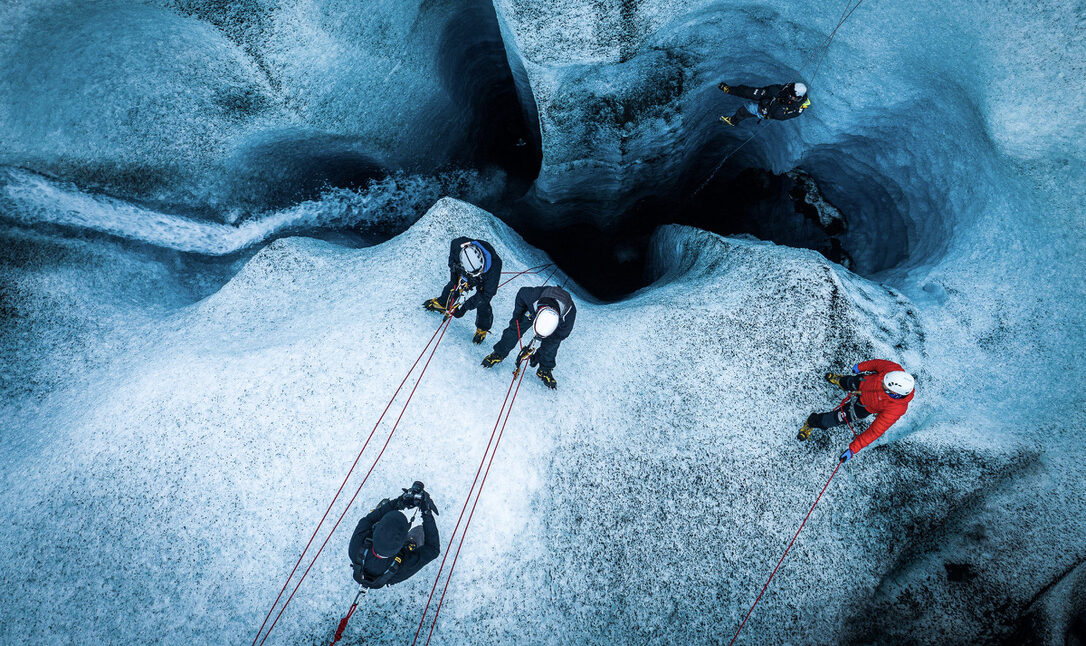
On a Studio shoot in London with Will Smith. Read More
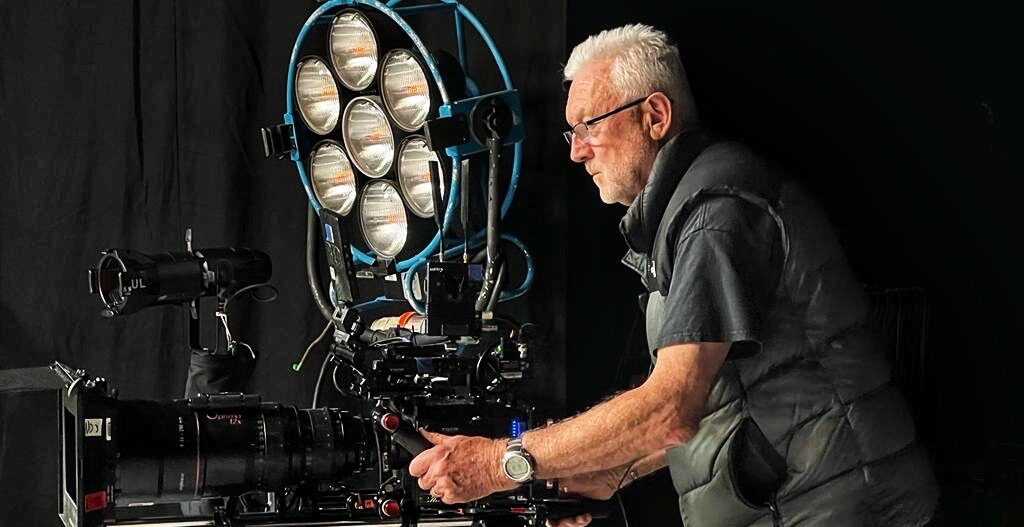
Taken by my Gaffer, Mark Gibbon. 8K RED Helium with Angenieux Optimo 12x.
I LOVE THIS PICTURE! Read More

This is one of my favourite photos, taken whilst filming the series ‘Galapagos 3D’.
David had just finished a piece to camera with the iconic Marine Iguanas in the background. I just had to jump in and get a picture. If you can’t get a photograph in the Galapagos with Charles Darwin (a bit hard) then it has to be with David Attenborough!! I admit it was a little unprofessional of me, but I do have this as a great memory of the moment.
Photo by Rob Hollingworth
Epupa Falls, Namibia. Phantom VEO & Canon 300mm FD lens Read More

Filming Will Smith and Explorer Albert Lin as they explore the falls. The series ‘Welcome to Earth’ streams on Disney+. A real pleasure to work with such talent!
In this shot I was filming at 938fps to slow down water droplets from the waterfall. As they fall, some of them ‘parachute’. The air forces them into a parachute shape and they then ‘explode’ and fall apart.
Filming another series with Will Smith - somewhere very remote!! Read More
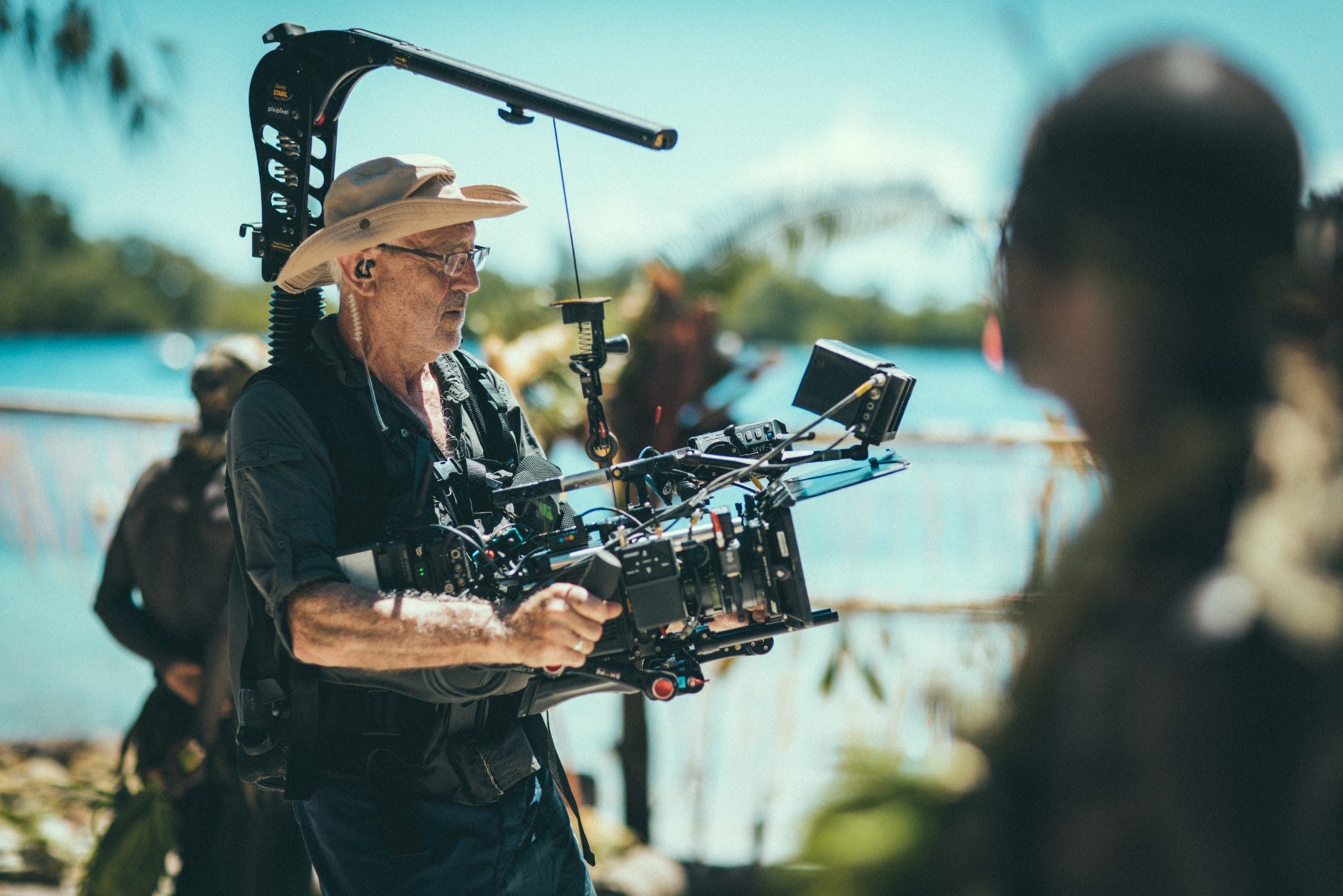
ARRI Mini LF, Zeiss Supreme 85mm, EasyRig with Stabil arm
Photo by Freddie Claire
Basalt Canyon, Iceland. RED Gemini & CN20 (50-1000mm Lens) Read More

Again Filming with Will Smith who was Kayaking through this extraordinary Canyon.
In Wyoming with Tony Robinson Read More

In Wyoming on a shoot with Sir Tony Robinson about the real Wild West in 3D.
Using unseen 3D stereographic images, Tony sets out to challenge some of the myths about the Wild West created by Hollywood and examines how Western pioneers, like Buffalo Bill, created their own legends that are still told to this day.
View the Discovery Channel TRAILER
Yardangs in the Egyptian White Desert Read More

These amazing structures are formed by wind-blown sand eroding the base. When viewed from above, they resemble the hull of a boat.
The word Yardang comes from the Turkish word “yar” which means “steep bank or precipice.” According to the Oxford English Dictionary, the word Yardang was first introduced to the English language in 1904 by the Swedish explorer Sven Anders Hendin.
Wikipedia describes them as ‘a streamlined protuberance carved from bedrock or any consolidated or semi-consolidated material by the dual action of wind abrasion by dust and sand, and deflation which is the removal of loose material by wind turbulence’. There you go, now I’m sure you fully understand!!!
'Lonesome George' the last of his kind. Read More

This is ‘Lonesome George’ the last of the Giant Pinta Tortoises (Chelonoidis nigra abingdonii).
The Galapagos island of Pinta was an easy target for the ships that came here. The sailors would take live Tortoises back to the ship, where they could stay alive for weeks/months as a source of fresh meat! The Pinta Tortoises were hunted to extinction, or so it was thought. George was found wandering on Pinta on 1st November 1971, long after the hunting had stopped. He was taken to Santa Cruz Island where many attempts to mate him with other sub-species of Giant Tortoises all failed. The Pinta Tortoise was pronounced ‘functionally extinct’.
Sadly he passed away only two weeks after this was taken – we were still in Galapagos when we heard the news! On 24th June 2012 Fausto Lierena (in the green shirt), his caretaker of 40 years, found him. Fausto was, of course, devastated!
To film him, we had to get all our bulky 3D gear into his pen before first light. At first he was very wary of us. He must have seen an army of vets and scientists over the years and he probably thought we were there to poke and prod him once more. We were very respectful of his fears and quietly, cautiously moved around his pen so we could shoot a classic piece to camera with David Attenborough. As you can see though, he eventually overcame his fears and started to trust us – he became fascinated with me and especially the 3D camera’s mirror box.
It was a privilege to spend time in his presence. It breaks my heart to think that scientists may have now found 17 tortoises that are partially descended from the same subspecies as Lonesome George, leading them to speculate that related purebred individuals of that subspecies may still be alive! In December 2015 it was reported that the discovery of another species (Chelonoidis donfaustoi) by Yale researchers had a 90% DNA match to that of the Pinta tortoise and that scientists believe this could possibly be used to resurrect the species.
Source: https://en.wikipedia.org/wiki/Lonesome_George
Photo by James Manisty
Whooper Swans from the Attenborough Series 'CONQUEST OF THE SKIES' Read More

Three of the imprinted Whooper Swans we filmed in 3D for the Attenborough Series ‘CONQUEST OF THE SKIES’ showing on SKY3D & SKY ATLANTIC.
Rose and Lloyd Buck raised these wonderful birds. Specifically, Rose spent 24hrs a day with these four birds for the first few weeks of their lives. Now they see her as ‘Mum’ and will follow her anywhere – even in a fast boat with a big 3D camera!
There’s also a ‘Making of’ so you can see how we did it.
SharkCam gets attacked - check out the teeth marks! Read More

Leaving the Mexican island of Guadalupe behind, this is SharkCam. Built by the Woods Hole Oceanographic Institution, it carries 5 cameras in its nose.
Using a special tag that SharkCam can follow, we can tag a Shark at the surface and it will film the behaviour of that Shark for hours. In the Bahamas once we followed a Bull Shark for 17 hours.
In Guadalupe I was filming with Big Wave for Discovery. We were tagging Great Whites and getting the first ever footage of their behaviour at depth. We were hoping to catch a Great White using a vertical attack on a Northern Elephant Seal at depth – something never seen before. We did film vertical attacks, just not in the way we expected. Check out the teeth marks on SharkCam!
Watch the video from Woods Hole Oceanographic Institution:
JOE KITTINGER – the real “Right Stuff’ Read More

I had the pleasure of taking my very first Balloon ride with this man – Colonel Joe Kittinger (USAF retired). He was part of Project Excelsior, a high-altitude balloon flight project.
On August 16, 1960, Joe made a high-altitude jump from a Helium Balloon at 102,800 feet (31,300 m). Towing a small drogue parachute for initial stabilization, he fell for 4 minutes and 36 seconds, reaching a maximum speed of 614 miles per hour (988 km/h) before opening his parachute at 18,000 feet (5,500 m).
Kittinger set World Records for the highest balloon ascent and the highest parachute jump. He also set historical numbers for the longest-duration drogue-fall (four minutes), and fastest speed by a human being through the atmosphere. His World Record jump was not beaten until 2012 – 52 years!
Actually, he was also the first man to make a solo crossing of the Atlantic Ocean in a gas balloon, and the first man to fully witness the curvature of the earth.
The pressurisation for his right glove malfunctioned during the ascent and his right hand swelled to twice its normal size, but he still rode the balloon up to 102,800 feet before stepping off.
Respect!
Source: https://en.wikipedia.org/wiki/Joseph_Kittinger
Filming Humming Birds for David Attenborough's 'Conquest of the Skies 3D' Read More

Filming for David Attenborough’s ‘Conquest of the Skies 3D’ – in Tandayapa Ecuador.
Hugh Campbell and I went to film Humming Birds (you can just see a couple of them on the red feeders). This is my Hurricane Rig with 2x RED Epics. To slow down the wing beat of these amazing birds we also had a 4K Phantom Camera which can shoot 4K up to a crazy 938 frames per second!
Malpelo - a remote island off the coast of Colombia Read More

Malpelo – a remote island off the coast of Colombia. Filming Masked Boobies for a Wildlife Feature about Colombia.
I was there specifically to film ‘obligate siblicide‘. The Boobies lay two eggs but will only raise one chick to maturity – it’s a way to ensure that at least one chick survives in case the first egg does not hatch. Great for the surviving chick, not great for the weaker one who eventually gets pushed out of the nest by its Sibling to get eaten alive by the land crabs that infest the island!! You can see red crabs if you look closely. Another example of where nature can be cruelly efficient.
My assistant and I had to stay on a ‘Live-aboard’ dive boat and everyday climb a precarious wooden rope ladder off a boat in the Pacific swell. The swell was so large on our last day that we had to jump the 30ft into the Ocean, as it was too dangerous to use the ladder onto a violently pitching boat. Never mind that the waters there are teaming with Galapagos Sharks and Hammerheads. Just another day at the ‘office’!!
Filming 'Flight of the Butterflies' in Mexico Read More

Filming ‘Flight of the Butterflies’ at the Monarch Butterfly Biosphere Reserve in the Mexican state of Michoacán.
My wonderful Mexican crew had to move a Technocrane after the first shot of the day. They just lifted it off its base and carried it downhill – brilliant!
You can see that they are surrounded by millions of Monarch Butterflies.
Filming drama on 'Flight of the Butterflies' 3D IMAX Read More

This is the house of famous artist Frida Kahlo in Mexico City.
Our amazing Mexican art department turned this into the office of Fred Urquhart, the Canadian entomologist who’s life’s work was to figure out the life cycle, migration route and ultimately the remote hibernation spot of the Monarch Butterflies.
The Monarchs have one of the longest migrations of any insect.
....and we managed to squeeze a Technocrane in here too!! Read More

Not sure how, but we did manage to get a Technocrane in here with a full 3D RED Epic rig on it.
Asiatic or Persian Lions in the Gir National Park, India Read More
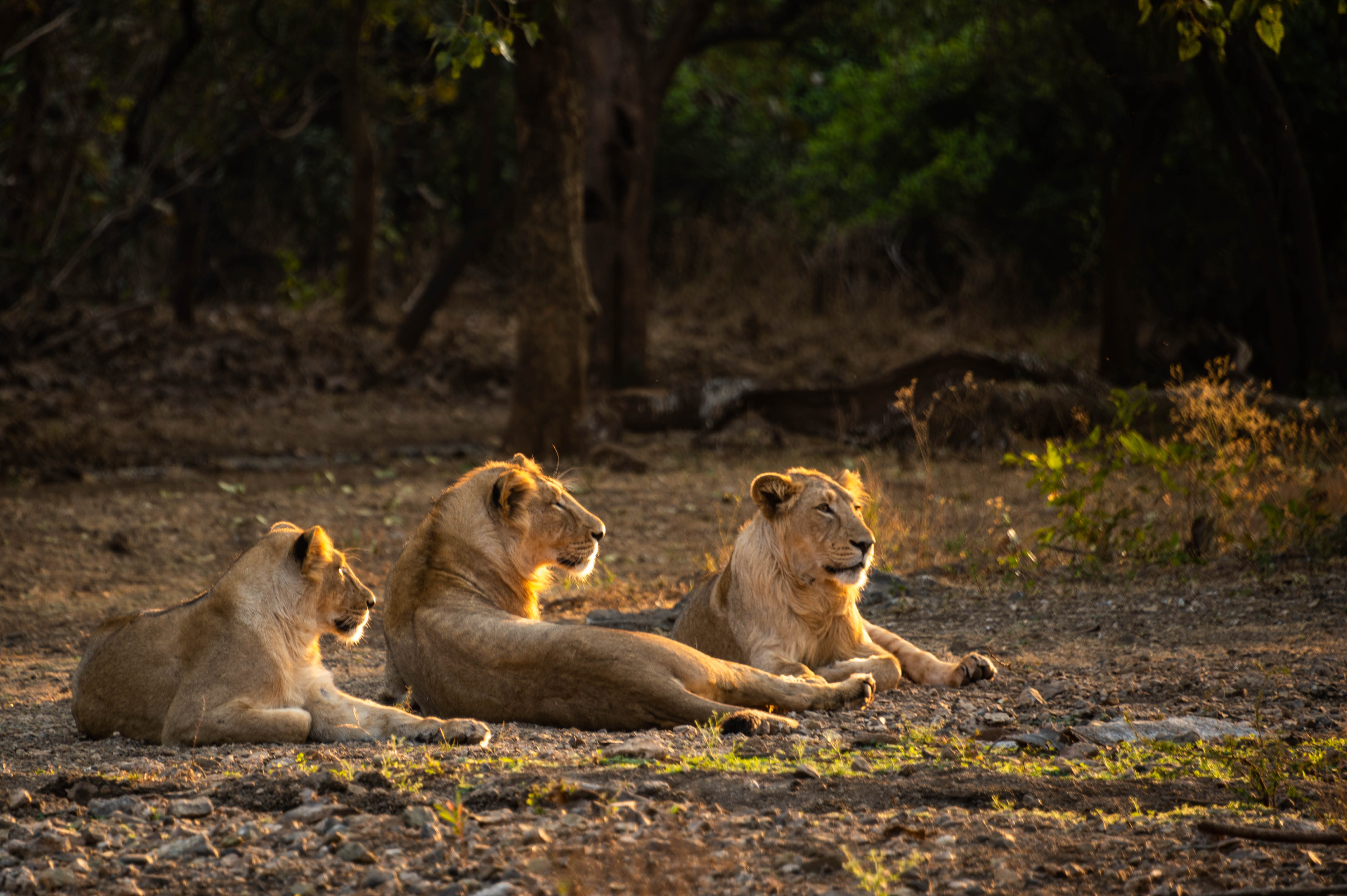
I had the pleasure of getting access to these marvellous lions – smaller than their East African cousins. There are only about 600 left in the wild. Historically their range was throughout SW Asia to Northern India.